
We keep telling the wrong founding story of Yellowstone
The seductive drama of Truman Everts—and the better alternative

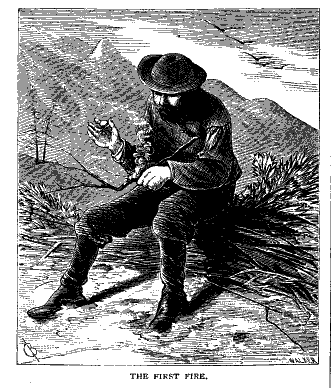
A few months ago, a friend asked me, “Do you know this story about Truman Everts, lost for weeks in Yellowstone in 1870?”
“Yeah.” I tried to shrug, hoping to blunt the force of the argument I feared was coming.
“I find it fascinating!” he said. Yup, here was the implied argument: I should have written more about it in my book about Yellowstone, Wonderlandscape. And I’ll admit the argument’s power: it’s one hell of a story.
In the thick forests and fallen timber south of Yellowstone Lake, 54-year-old Truman Everts—the oldest, least athletic, and most nearsighted of his group of explorers—got separated from the others. Soon his horse bolted away. It had his gun, blankets, matches, and nearly everything else he would need to survive. The others sent out numerous search parties, but September snowstorms, soon totaling two feet in accumulation, obscured his tracks. They lingered for almost a week, and left a small search party for another several days, but running low of food themselves, had to head back to civilization.
At first Truman waited near a hot spring, subsisting mostly on thistle roots. On two occasions the search parties were within a half-mile of him, though neither knew it. Truman eventually headed north along the lake, and was able to retrace his incoming trail. He could make fires with his opera glass, although later he lost it. He also lost his homemade sandals. He suffered frostbite, a scalded leg, and scorched hair from a campfire. On October 6, 37 days after he’d initially gone missing, he was rescued by another party come from Helena. They described him as shoeless in the cold sleet, with clothing in shreds, weighing about 50 pounds, inarticulate and irrational. But he lived.
Given such drama, I can totally understand why any storyteller would put Truman Everts front-and-center in the history of Yellowstone. But note how this story frames the park’s central tension: it’s a lone white man versus the wilderness.
If you start a book with that story, every subsequent story should expand on its themes. How did development help white men conquer the wilderness? How did these vast landscapes provide opportunities for other white men to test themselves against wilderness dangers? How did the National Park Service balance the preservation of this wilderness (these dangers) with making it accessible to the general public?
But today’s culture is less enamored of heroic-white-man narratives, landscapes as places to be conquered, and wilderness as danger rather than wonder. Everts-type stories are at best overexposed, and at worst a fundamental misunderstanding of Yellowstone and its role in American identity.
To me, the 1870 expedition represented many of the worst aspects of mainstream American culture at the time. Its military leader, Gustavus Doane, was fresh off the Marias Massacre, where he’d participated in the killing of about 200 Piegan Blackfeet people (mostly women, children, and old men). When I was reading George Black’s Yellowstone history book Empire of Shadows, I kept wondering why the park didn’t show up until three-quarters of the way through the book. Then I realized what Black was arguing: the 1870 expedition was entangled with Indigenous genocide, making it problematic as a founding mythology.
It’s problematic in other ways, too. These weren’t the first white people in Yellowstone, merely the most elite. Early fur trappers may have been illiterate; men on an 1869 expedition didn’t have political or publishing connections. By comparison, the chief 1870 promoter, Nathaniel Langford, followed up with hundreds of sponsored speeches, sounding about as trustworthy as a used-car salesman—all the more annoying because the car isn’t here in front of us but off somewhere in Wyoming.
And then there’s Everts: probably a nice guy, but totally unqualified to be there. He’d been foolishly invited by the expedition’s political leader, Henry Washburn, a bureaucrat on a boondoggle. If Everts had kept any sort of diary, we might have a blow-by-blow account of a man both resourceful and desperate, of a landscape both beautiful and terrifying (in a favorite word of the era, sublime). But he didn’t, so instead we have a glib adventure narrative: “Yellowstone almost killed him!”
Stories of Yellowstone’s founding sometimes conflate the 1870 Washburn/Doane/Langford expedition with Ferdinand Hayden’s 1871 expedition. But in fact Hayden’s trip is a contrast, an alternative, a rival. Indeed, it represented some of the best aspects of mainstream American culture at the time: It included plenty of diverse scientists making factual observations. It was professionally organized under an official Congressional appropriation. It welcomed photographers including William Henry Jackson—plus an artist, Thomas Moran.
When you start a book with the story of Thomas Moran, every subsequent story can expand on art and culture. How did Moran’s paintings and Jackson’s photographs change the way Americans perceived the West? How were those meanings expanded through architecture (the Old Faithful Inn) and cartooning (Yogi Bear)? How did Yellowstone provide opportunities for varied cultural figures to continually redefine America through its signature landscape?
That’s what I tried to do in Wonderlandscape. I did get to mention Truman Everts’ escapade, as well as the important-if-true campfire comments of his 1870 co-expeditioner Cornelius Hedges. The Everts and Hedges stories played a surprising role in a 1926 debate over the script of the park’s official pageant.
I didn’t want to ignore Everts, his suffering and bravery. I just wanted to keep him in perspective. When it comes to the history of Yellowstone, what’s important isn’t just drama, like Everts’ story. It’s how those stores are remembered, and what they are believed to mean.
End notes:
Aubrey Haines, the dean of Yellowstone historians, presents the most vigorous characterization of Langford as untrustworthy. See, for example, pp. 67 and 342-3 of The Yellowstone Story, vol. 1. Other good books on this topic include Anne F. Hyde, American Vision: Far Western Landscape and National Culture 1820-1920 (NYU Press, 1990); Thurman Wilkins, Thomas Moran: Artist of the Mountains (University of Oklahoma Press, 1998); James Cassidy, Ferdinand V. Hayden: Entrepreneur of Science (U. Nebraska Press, 2000); and Peter Bacon Hales, William Henry Jackson and the Transformation of the American Landscape (Temple University Press, 1988). M. Mark Miller’s Rediscovering Wonderland (Two Dot, 2022) has a comprehensive account of Everts’ adventure.
Wonderlandscape is now available in paperback!
If you are in the Cody, Wyoming, area on Thursday, August 6, I’d love to see you at my free Lunchtime Expedition talk at the Buffalo Bill Center for the West, at noon.
Reminds me of the conclusion to one of the great motion pictures of the Western genre.... how its theme is intertwined with the story you share..... seems there's been a lot of printing of the legend... and not just on the silver screen.
https://www.youtube.com/watch?v=363ZAmQEA84
Fascinating!